

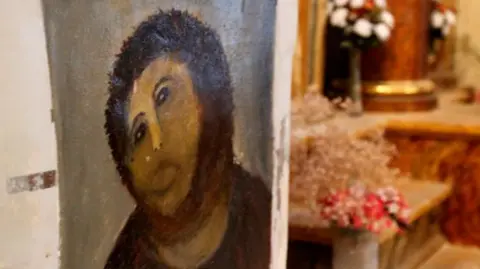
The Spanish parishioner who achieved global fame for her poorly executed repair job on a cherished Jesus Christ fresco has died at the age 94.
The woman, from the town of Borja in northern Spain, rose to prominence 13 years ago after she undertook to restore a 100-year-old fresco titled Ecce Homo located in her parish church.
Giménez's handiwork quickly went viral and earned the moniker "Potato Jesus", because the altered likeness of Christ's head bearing a resemblance to a hairy monkey.
Local Confirmation and Tribute
The nonagenarian's death was announced by the town's mayor, Eduardo Arilla, in a social media post, where he acknowledged her as a "great enthusiast of painting from a young age".
"Descansa en paz Cecilia, your memory will live on with us," the mayor posted.
Arilla also paid tribute to Giménez's "now-legendary restoration of Ecce Homo" in August 2012, which "due to the poor state of conservation it presented, Cecilia, with the best intentions, chose to repaint the work over".
The Painting's Background and the Now-Infamous Act
The Ecce Homo ("This is the Man" in Latin) by 19th century painter Elias Garcia Martinez had been held for more than a century in the Sanctuary of Mercy Church close to Zaragoza.
At the time, Giménez, then 81, stated that church members had "traditionally fixed everything here", and that she had been given the go-ahead from the parish priest to do the work.
She also noted that anyone who came into the Church would have seen she was painting over the original artwork.
A Surprising Tourist Boom
The aftermath of the restoration led to the creation of the "Ecce Mono" meme and saw the previously sleepy town of Borja quickly become a major tourist destination.
The town, which had previously seen only 5,000 tourists per year, attracted more than 40,000 tourists by 2013, and generated over €50,000 for charity from the interest.
Today, local authorities say that between 15,000 and 20,000 tourists travel to Borja every year to see the famous portrait, which is now protected by a protective shield of glass.
Later Life and Local Admiration
Following the wave of criticism, backed by the townspeople and well-wishers globally, Giménez went on to hold an art exhibition showcasing 28 of her personal paintings.
She was commended by the mayor for her generosity and decades of dedication to the parish.
Ultimately, what began as a well-intentioned but flawed act of restoration forged an improbable cultural icon and brought remarkable attention and resources to a humble Spanish town.


